Contracting in the Age of AI: Rethinking Contract Management with Thirdway’s Anthony Armitage

Updated: Dec 4, 2025

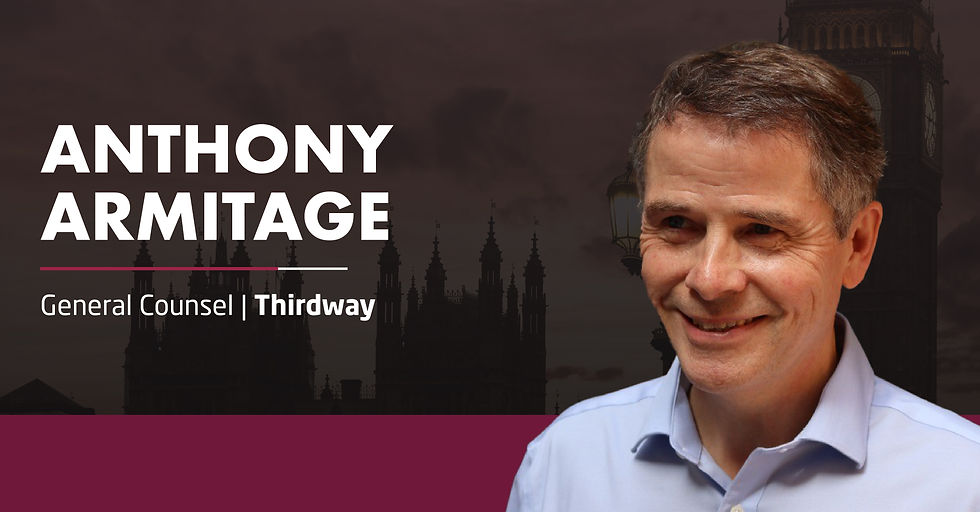
We recently sat down with Anthony Armitage, General Counsel at Thirdway, who will be speaking at Future Contracts London on 10th December.
Anthony brings extensive experience across the legal landscape. Alongside his role at Thirdway, he serves as Contract Group Chair at the Conflict Avoidance Coalition, where he advocates for contract standardisation within the construction sector. He leads a team of lawyers and industry professionals focused on intelligent contract design and simplification - restoring contracts to their purpose as practical business tools and strengthening conflict avoidance.
With years of experience working with contracts - long before the rise of AI - Anthony now plays a key role in helping legal and commercial teams navigate the rapid adoption of AI and the impact it has on contracting practices.
At Future Contracts London, Anthony will share his insights during the panel “AI, Speed, and Safety: Rethinking Risk in Contracting” where he’ll be joined by experts from Endava, Menzies Aviation, and Inspired Education Group.
Enjoy the interview, and we look forward to welcoming you at Future Contracts London!
How do you hope your participation at Future Contracts London will influence the way the audience thinks about the future of contracts?
This is a back to the future moment, and contracts are at the heart of the drama. The innovation debate about contracting has sparked a new focus on what contracts really are, and the construction sector provides the perfect backdrop to explain what is happening.
Since 1866 the building industry has been blessed with a range of standards form contracts which are intended to be, and are generally accepted as being, fair and balanced between the parties for the projects for which they are designed. Over many decades, the benefits of this standardisation have been eroded by amendments, added complexity and bespoke drafting.
The term ‘contract’ is used by lawyers to describe the legal wrapper that makes the underlying agreement enforceable. It is not the agreement itself. To have an agreement there must be complete understanding by the parties of what has been agreed, otherwise there is no matching offer and acceptance. Standard form building contracts like the JCT have a standard set of conditions, which are understood by the parties using them. The contract particulars of the JCT are the commercial aspects of the deal, and they will change for each project, but the conditions should always stay the same.
In our session we will explore ways that AI can generate better understanding of the underlying agreement in every contract.
How do you think AI tools are reshaping expectations around contract visibility and accountability?
AI can bring contracts into crisp relief from the shadows of technical legal analysis and display them as the business tools they are intended to be. Traditionally lawyers see their role through a narrow lens focussing on the wording of clauses, but they do not see the wider commercial landscape. After much trial and error, we realised the skills we had learned and developed as lawyers did not lend themselves well to adopting AI in practice.
The problem we faced was how to understand the changes made to the standard form contracts we use by stand-alone sets of amendments. Before AI we would carry out a visual comparison of the standard form against the amendments and engage in mental gymnastics to construe the meaning of the combined texts. Initially we asked the AI tool to create a redline version so we could read the contract as a whole. We found that AI was not able to do this accurately. We changed our prompts to ask for an explanation of how the amendments changed key functions of the contract, and the output from the tool was far better. We can now create a simple table in seconds that sets out how operational functions under the contract have changed and summarises the associated risks for our business.
This approach can be replicated for all types of contracts, by using industry-specific playbooks and standard forms.
Thinking ahead, what excites you most about the future of legal practice in contracting?
AI heralds a new era of transparency in contracting. It peels away layers of legal complexity to reveal how contracts can become much more effective business tools. I predict this will be a process of spreading contract standardisation that will strengthen new industries providing clarity, reducing delays and delivering value. Beyond efficiency it will create a fair and predictable foundation for contracting parties by balancing risk, improving workflows and fostering a collaborative approach that minimises conflict and maximises success.



Comments